

Critical operations often still run on a decades-old legacy software system that mobile apps, partner portals and analytics tools can’t easily use. Legacy system integration with modern APIs closes that gap without a risky rewrite. This guide covers six proven approaches and how to choose and plan one. If your team lacks capacity, see how Storium can facilitate API integration as part of its IT development outsourcing services.
What Is Legacy System Integration?
Legacy system integration is the practice of connecting older software with newer applications so that data and functions move between them. The integration of legacy systems rarely means replacement. Instead, teams expose existing business logic through standard interfaces such as REST or event streams, while the old platform keeps doing what it does best.
This work is a core part of enterprise application integration, the wider discipline of linking CRM, ERP, finance and custom tools into one landscape. Practical legacy application integration is usually harder than it sounds, because a typical legacy API, if it exists at all, speaks SOAP, flat files or a proprietary protocol. That mismatch explains why a translation layer sits at the heart of almost every project.
Why Integrate Legacy Systems with Modern APIs?
- Modern APIs Drive Digital Transformation and Cloud Adoption. Once business data is exposed through standard interfaces, cloud services, SaaS products and AI tools can consume it directly. In this sense, API modernization is often the first practical step of digital transformation, not a distant goal that waits for a full platform replacement.
- Modern APIs Improve Customer Experience. Customers expect real-time order tracking, instant quotes and consistent data in every channel. With integration APIs in place, a decades-old back office can power a slick mobile experience, and nobody outside the IT department notices how old the engine underneath really is.
- API Integration Reduces Operational Costs. A full rewrite of a core platform can consume years and millions. Well-planned API integration preserves proven business logic, removes manual re-keying and replaces fragile point-to-point scripts with maintainable interfaces.
- Integration Improves Business Agility. A clear API integration strategy lets teams launch new channels, onboard partners and test ideas in weeks instead of quarters. Every new product reuses existing interfaces, so progress compounds. Done step by step, legacy application modernization also spreads cost and risk over time instead of concentrating them in one big-bang release.
Key Approaches to Legacy System Integration with Modern APIs
No single method fits every case, and the most common API integration patterns are frequently combined. To keep the comparison concrete, each example below features NorthPeak Retail, a fictional mid-sized retailer whose 20-year-old order management system runs on a mainframe.
API Wrapper: The Fastest Path to Integration
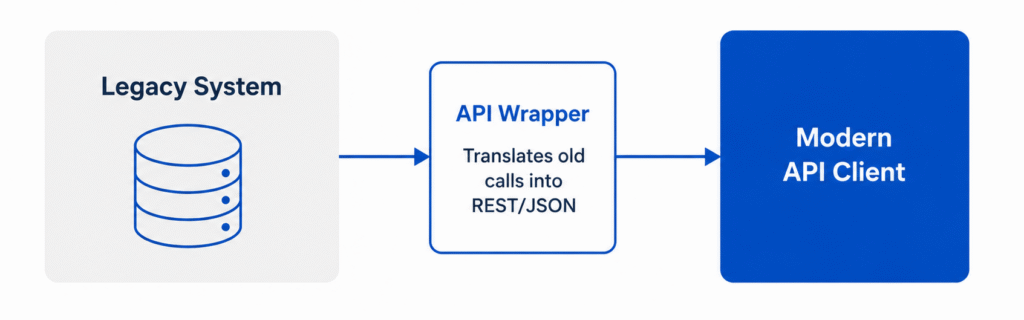
An API wrapper is a thin service placed in front of the old system. It accepts a modern request, for instance JSON over HTTPS, translates it into a call the legacy code understands, and converts the response back. Solid API RESTful design matters here: clear resources, standard verbs and predictable error codes make the wrapper easy for any developer to adopt. Spring Boot, Node.js with Express and Apache Camel are popular choices for building one.
Middleware and ESB Integration
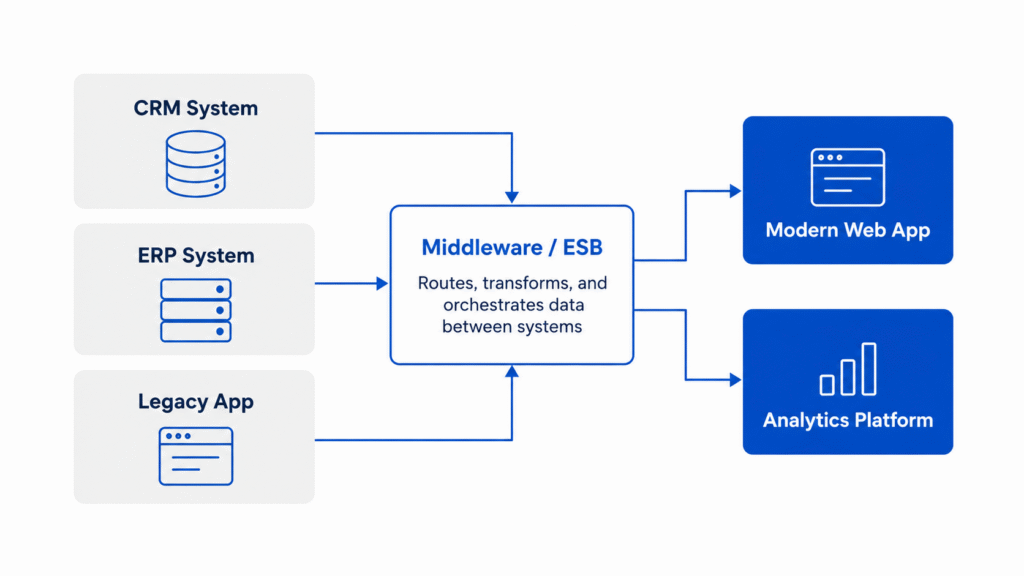
Middleware integration places a central layer between applications: each system connects once to the hub instead of to every other system. The classic form is the enterprise service bus, and ESB integration still dominates in banking and insurance. Application integration middleware handles routing, format conversion and monitoring in one place, with MuleSoft Anypoint and WSO2 as well-known platforms. Teams that want something lighter often choose middleware for REST API integration instead of a full bus.
The gains are central control and reuse; the risks are a single point of failure and high licensing costs. NorthPeak Retail connects its CRM, ERP and mainframe order application through MuleSoft, so the web store and analytics platform receive one consistent data stream. Middleware API integration fits environments where many systems exchange data and governance matters.
Anti-Corruption Layer (ACL)
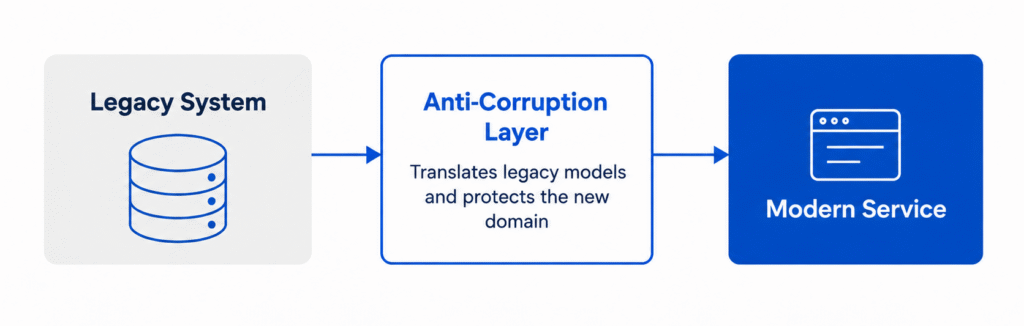
The anti corruption layer pattern comes from domain-driven design. An anti corruption layer sits between a legacy system and a new service and translates models in both directions, so outdated naming, codes and data structures never leak into fresh code.Teams typically implement it as a standalone service or a shared library, written in whatever language the new stack already uses.
Message Queue Integration
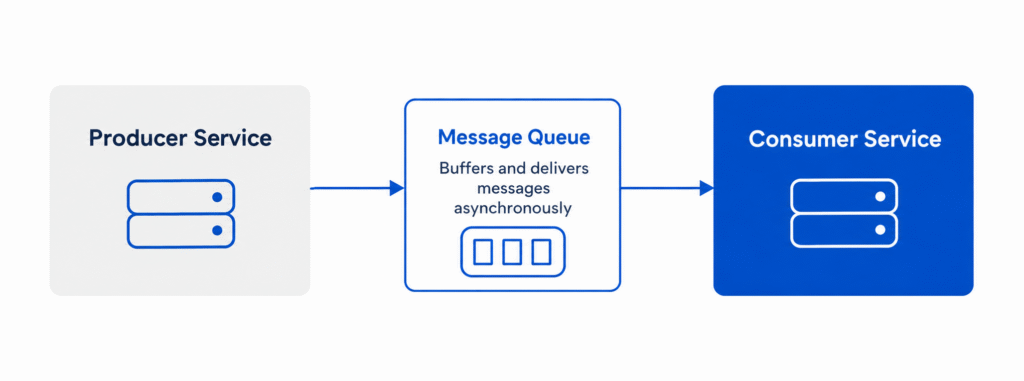
Message queue integration decouples systems by letting them communicate asynchronously. A producer publishes a message, the broker stores it, and a consumer processes it when ready. This message queue integration pattern absorbs traffic spikes and keeps a slow legacy back end from blocking the front end. RabbitMQ, Apache Kafka and Amazon SQS are the usual brokers.
API Gateway Pattern
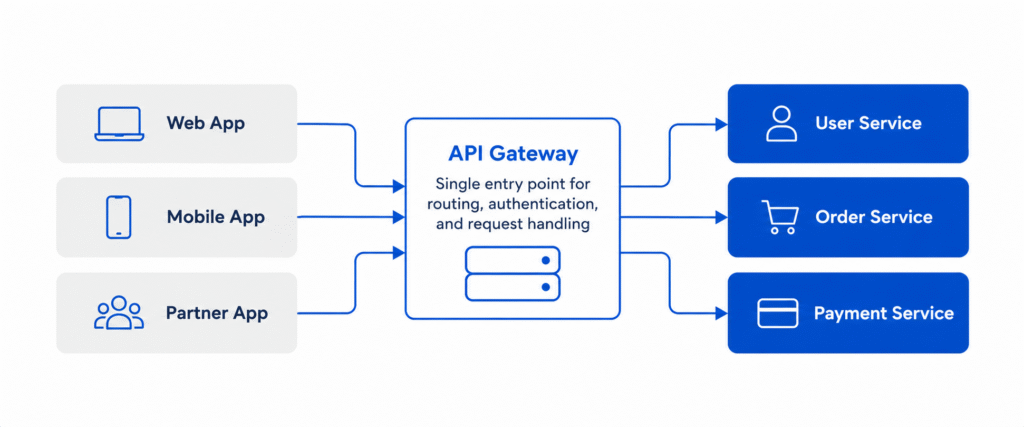
All client requests pass through one common front door: the API gateway. It routes requests to backend services and handles authentication, rate limiting, caching and logging. An API gateway for legacy systems adds a modern security and traffic layer to platforms that were never designed for the open internet. Kong, Apigee, AWS API Gateway and Azure API Management lead the market.
How does API gateway deal with legacy SOAP applications? Through protocol mediation: it accepts REST and JSON from clients, converts the request into SOAP and XML, and returns the answer in JSON. Combined with legacy integration with API management, which adds developer portals, versioning and analytics, the gateway turns internal functions into governed products.
Centralized security and simpler clients are the advantages. The disadvantages are one more component to scale and no cure for a slow back end. NorthPeak Retail’s web app, mobile app and partner portal call a single gateway, which routes traffic to user, order and payment services, including a SOAP payment module on the old platform. This pattern suits companies with many client types or external partners.
Strangler Fig Pattern and Microservices Migration
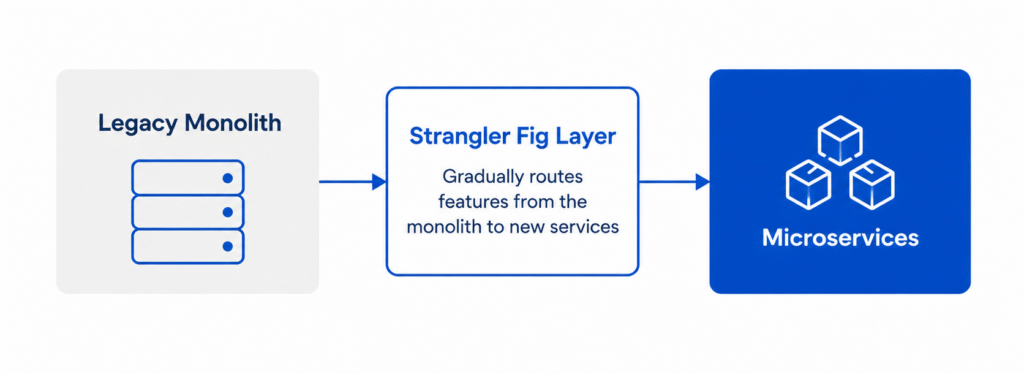
The strangler fig pattern replaces a monolith gradually. A facade, usually a proxy or gateway, intercepts requests. New microservices take over one function at a time, while everything else still reaches the old system. When the last function moves, the monolith can be switched off. Microservices migration done this way avoids a big-bang cutover. NGINX, Kong or AWS API Gateway can act as the routing facade, and Debezium helps keep data in sync.
Incremental value and easy rollback are the main benefits. The price is a long timeline, two systems running side by side and tricky data synchronization. NorthPeak Retail first moves its product catalog to a new service, then pricing, then orders. Choose this route when the long-term goal is a full exit from the old platform rather than a lasting bridge.
How to Choose the Right Integration Approach
Start from the business goal, then match it to constraints. Need a result this quarter? A thin layer around an existing API may be enough. Many systems exchanging data? Consider middleware. Protecting a new domain model? Use an anti corruption layer. Spiky load? Add a queue. Many client types? Put a gateway in front. Planning to retire the old platform? Follow the strangler fig route.
Team skills, data volume, latency targets, compliance rules and budget should also weigh in. Most real projects blend legacy integration patterns: a gateway in front, a wrapper in the middle, a queue behind. Whatever the mix, define the overall API integration architecture before coding, and decide how each API legacy application pair will exchange data and handle errors. Choosing the right software architecture patterns early prevents expensive rework later.
Common Problems When Integrating Legacy Systems with APIs
Even well-run projects hit the same obstacles. For more detail, read about the common reasons API integrations fail. Here are the five most frequent ones and the standard fixes.
- Technology incompatibility. Use API wrappers, middleware, or an anti corruption layer to translate data and isolate legacy dependencies.
- Security vulnerabilities. Old platforms often lack modern authentication and encryption. Place them behind a gateway, enforce OAuth 2.0 and TLS, segment the network and run regular audits.
- Performance bottlenecks. Cache frequent reads, queue heavy writes, set rate limits and load-test before launch.
- Data consistency issues. Pick one source of truth per data type, use event-driven synchronization with idempotent operations, and schedule reconciliation jobs.
- Lack of documentation. Capture real traffic, interview long-serving staff, write contract tests and document every interface as you build it.
How to Plan a Legacy Integration Project?
A structured plan keeps scope under control.
- Audit the landscape. Inventory systems, interfaces, data flows and owners.
- Set business goals and metrics, such as order processing time or error rate.
- Select the approach and validate it with a small proof of concept.
- Design interface contracts, including data formats, versioning and error handling.
- Build security and monitoring in from day one: authentication, logging and alerts.
- Pilot with a low-risk function, test under realistic load, then fix what breaks.
- Roll out in stages, measure results against the goals and iterate.
Organizations should involve both business stakeholders and technical specialists at every stage, so that business goals and technology decisions stay aligned.
Frequently Asked Questions About Legacy System Integration
How long does legacy system integration typically take?
A simple API wrapper can go live in four to eight weeks. A middleware project connecting several systems typically takes three to six months, while a full strangler fig migration can run one to three years. Scope, documentation quality and team experience move these numbers the most.
Can legacy systems be integrated without replacing them?
Yes. Wrappers, gateways, middleware and queues all keep the old system running while exposing its functions through modern interfaces. Replacement then becomes a choice, not a necessity.
How can businesses minimize downtime during legacy system integration?
Run old and new paths in parallel, release behind feature flags, shift traffic gradually with canary releases and use queues to buffer requests during maintenance. Always prepare a rollback plan and rehearse it before launch.
How do APIs extend the lifespan of legacy systems?
APIs separate what a system does from how it does it. Once functions are available through stable interfaces, the back end can be tuned, moved to the cloud or replaced piece by piece without breaking the apps that depend on it. That keeps proven software useful for years longer.