

Why a Static Website May Work Well at First
Many businesses start with a simple online presence: a few pages describing the company, its services, and how to get in touch. At this stage, a static website is often the right call. Services rarely change, no one is publishing news updates, and the functionality needed is minimal – just information that visitors can read. Fixed static web pages load quickly, cost little to build, and require almost no ongoing website maintenance, since there's nothing dynamic happening behind the scenes.
There's no server-side processing to configure, no database to manage, and no risk of something breaking after an update – the site simply displays what was built into it. For a small company just getting started, or one testing a new idea before committing to a larger budget, this setup is economically sound: there's no reason to pay for complexity the business doesn't need yet.
Signs Your Business Has Outgrown a Static Website
As a company develops, its needs rarely stay the same. New services get added, the business expands into new markets or opens new locations, and leadership starts paying closer attention to seo website content – which depends on publishing fresh material regularly rather than leaving pages untouched for years. A growing team often needs dedicated pages for open positions or staff profiles, and customer support increasingly expects a live chat or an AI assistant built into the site itself.
These shifts tend to show up as the same handful of needs:
- Information has to be updated often, not just occasionally
- New pages keep appearing, and the site's structure needs room to expand
- The business wants to showcase case studies, a portfolio, or client reviews
- Leads need to come in through forms, not just a listed email address
- Analytics, a CRM, or other services need to connect directly to the site
Without frequently updated content and real time information in place, a site that once felt complete starts feeling incomplete – its website functionality simply wasn't built for this stage of the business. A company that once needed nothing more than an address and phone number now finds itself editing the same static file every time a price changes or a new hire joins the team, and each edit takes longer than it should.
A Dynamic Website as a Solution
A dynamic website pulls content from a database and assembles pages on the fly, rather than serving the same fixed file to every visitor. Content lives inside a cms – a content management system – so a marketing team can add pages, update text, or publish an article without touching a line of code. Behind the scenes, server side scripting generates each page as it's requested, which is essentially what is dynamic website technology comes down to: content that responds to context instead of staying frozen.
Once a business runs a website with CMS system, expanding the site becomes far less disruptive. New pages, new sections, and new features can be added incrementally, and dynamic content – from blog posts to product listings – updates on its own schedule instead of requiring a developer for every small change.
This shift also changes who can maintain the site day to day. Instead of routing every text change through a developer's task queue, a marketing coordinator can log into the CMS, edit a page, and publish it within minutes. That kind of independence tends to matter more than it first appears, especially for businesses adding content weekly rather than once a quarter.
How Dynamic Websites Support Business Growth
Because pages are generated from a database driven website structure, the same platform can support far more than static pages ever could. Interactive features – search filters, comment sections, customer accounts – become straightforward to add, and user interactions across the site can be tracked and improved over time rather than guessed at.
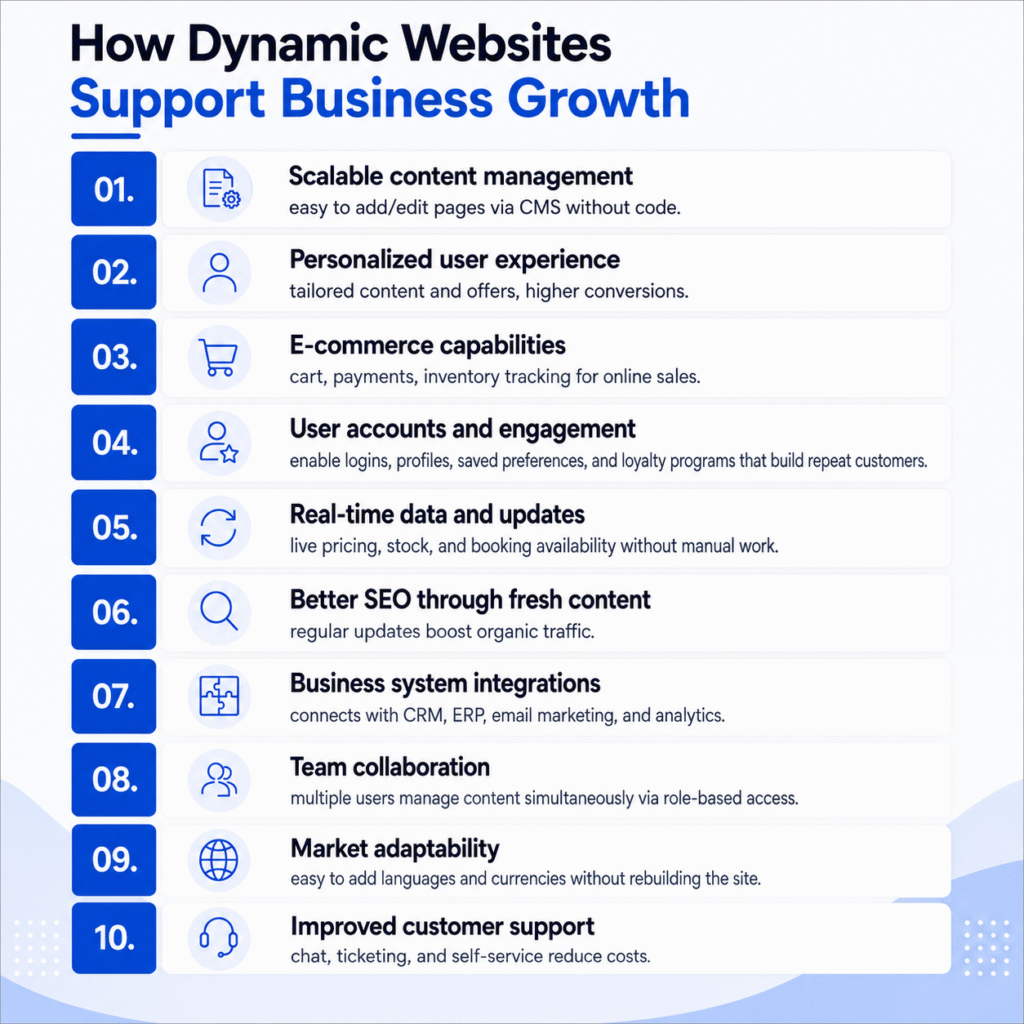
Database driven content also opens the door to personalization capabilities: showing different visitors different recommendations, offers, or messaging based on their behavior, location, or past visits. For businesses selling products online, this extends naturally into the capabilities of e-commerce – carts, checkout flows, order tracking, and inventory syncing that a static page simply can't support on its own. Built-in social media integration and real time updates keep the site connected to what's happening elsewhere, pulling in fresh posts or reviews automatically rather than requiring someone to copy them over by hand. Dynamic website features like live availability or pricing reflect changes the moment they happen, thanks to server side processing running behind every page a visitor loads.
A site built this way rarely hits a wall, the scalability of a website comes from adding capabilities as they're needed, not from tearing the whole thing down whenever the business asks for something new. Working with custom website development also means the site can be shaped around the exact way the business operates, rather than forcing the business to adapt to a rigid template built for someone else's workflow. All of this feeds back into stronger user experience, since visitors get a site that responds to them instead of one that stays the same no matter who's looking or what they're trying to do.
Choosing Between Static and Dynamic Websites
Deciding on a dynamic or static website comes down to how much the business needs to change over time and how the site is expected to grow.
| Feature | Static Website | Dynamic Website |
| Content updates | Manual code changes are required for every update | Content can be updated through a CMS without editing code |
| Scalability | Best suited for small sites with limited content | Easily expands as the business grows |
| Content management | Requires developer involvement for most changes | Marketing teams can update content independently |
| Functionality | Basic pages with limited interactive features | Supports forms, blogs, customer accounts, e-commerce, APIs, and more |
| Integrations | Adding third-party tools often needs custom development | Integrates more easily with CRM, analytics, marketing, and payment systems |
| SEO | Suitable for basic SEO but less efficient for frequent updates | Better suited for ongoing SEO through regular publishing |
| Maintenance | Simple when content rarely changes | More complex but significantly more flexible |
| Best for | Landing pages, portfolios, brochure sites | Growing businesses, service companies, online stores |
Both approaches have their place – understanding the benefits of static and dynamic websites side by side makes it easier to pick the one that actually matches where the business is headed, not just where it started. A landing page for a single campaign rarely needs a database behind it, while a company managing dozens of services and locations almost always outgrows what a fixed page can handle.
Is It Time to Upgrade Your Website?
Define Your Business Objectives. Get clear on what the site needs to achieve over the next year or two, not just what it does today. A site built to support a single service line looks very different from one meant to carry a growing catalog or multiple locations.
Consider How Often Your Content Changes. Frequent updates, new pages, or growing service lists are a strong signal that website upgrading is worth the investment. If updating the site has turned into a recurring task on someone's calendar, that's usually the clearest sign of all.
Evaluate Development and Maintenance Costs. Weigh the price of ongoing manual edits against the cost of a platform that manages itself – over time, the second option is often cheaper once developer hours are factored in. In rare cases, a business scales back and needs to convert dynamic website to static once its content stabilizes and updates become infrequent again, but that's the exception rather than the rule.
Think About Long-Term Scalability. Choose a setup that can absorb new features, pages, and integrations without requiring another overhaul a year later. Planning one step ahead of current needs usually costs less than rebuilding twice.
How Storioum Can Help
Moving from a simple brochure site to a fully dynamic platform isn't something to figure out alone, and getting the architecture right the first time saves both time and budget down the road. Storioum works with growing businesses to plan and build sites that match where the company is actually headed, not just where it started – from choosing the right CMS to structuring content so it stays easy to manage as the business expands.
Through website development support, the transition from a static setup to a scalable, CMS-driven platform can happen without disrupting the business along the way, keeping the existing site live while the new one is built and tested behind the scenes.